We secured 2nd place at the Gillmore FinTech Hackathon 2025, and I’m incredibly proud of what our team built. Among the four problem statements (debt management tools, loan explainers, banking solutions, and micro-investing), we chose the micro-investing challenge.
Students often want to start investing, but most platforms unintentionally create high barriers: complex interfaces, financial jargon, and the assumption that users already have capital and confidence. Our goal was to rethink this experience from the ground up.
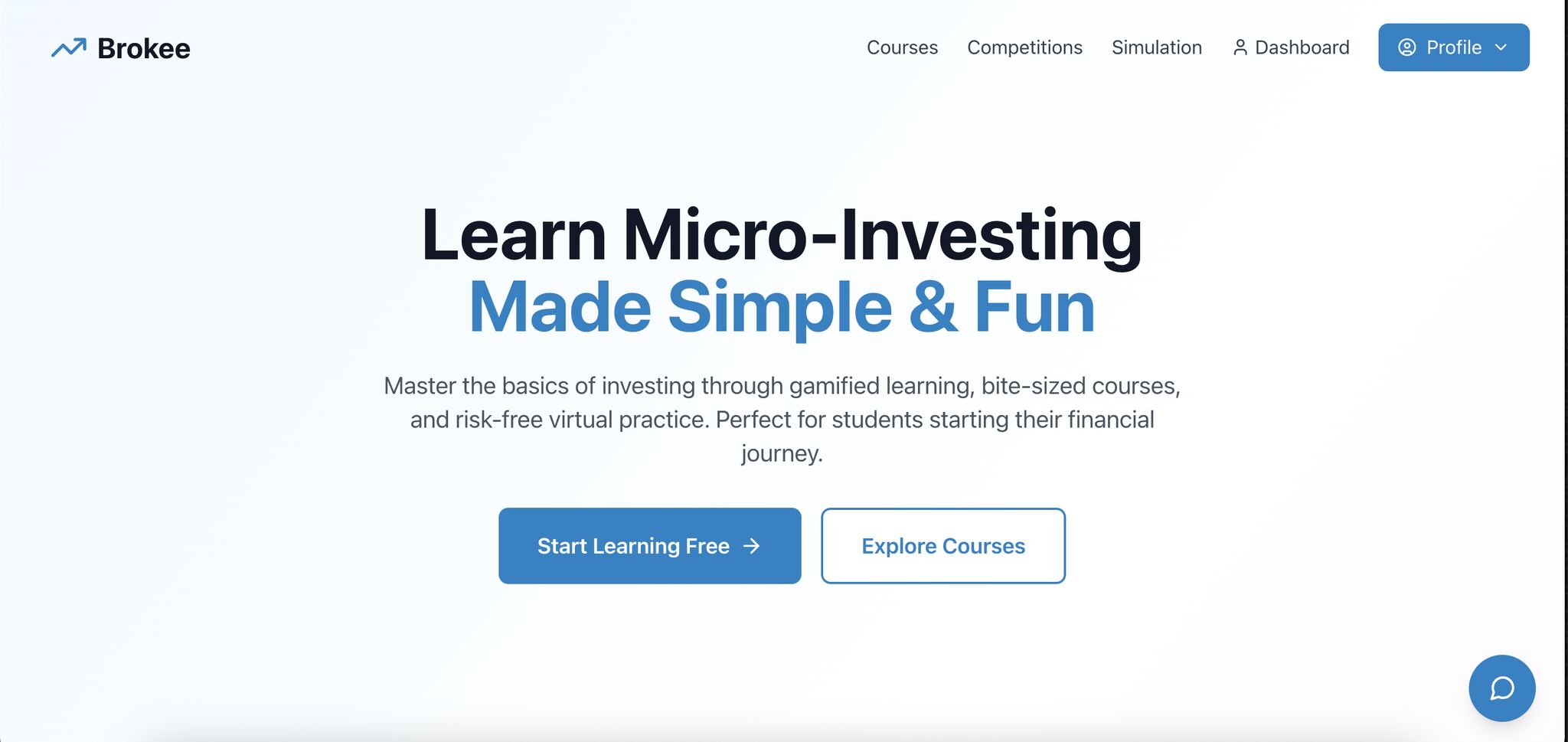
We built Brokee, a student-focused micro-investing platform shaped through a design-thinking lens. We began with desirability: What would make a student genuinely want to learn? What would make them return the next day? This led us to an experience centred on clarity, progression, and low-friction learning. We then evaluated feasibility, ensuring the platform could technically support adaptive modules, real-time data, and layered simulations. Finally, we focused on viability, creating systems that support long-term engagement through behaviour design, challenges, and peer-driven motivation.
Our solution brings these principles together through:
- A structured learning journey that unlocks real-market access after key concepts are mastered
- A simulation environment covering bull, bear, and crisis scenarios, including 2008-style downturns
- Competitions, savings challenges, and inter-university clans designed to create network effects
- Real-time market integration ensuring learning remains relevant and contextual
- A lightweight avatar layer that introduces the foundation for a future social/community dimension of the platform
Our MVP prototype of Brokee can be viewed here: investstart-tutb.vercel.app
I’m deeply grateful to my teammates Narayana Menon S, Shameer Hussain, Timothy Ninan, Ivan Chirkov and Fahad Khan for the creativity and momentum they brought throughout. My sincere thanks to Dr Bo Kelestyn PFHEA, and to my module leaders Jochem Hummel, Mo Moeini, and Zhewei Zhang. The concepts and frameworks from their classes played a significant role in shaping our approach. A special thank you to the judging panel (Dr. Kalina Staykova, Matthew Hanmer, Dan Philps, CFA, PhD, Ram Gopal) for their thoughtful feedback and guidance. And thank you to the WBS community and the Gillmore Centre for fostering such an innovative environment.